‘Foolish, negligent, and dumb’: Why big BBL change makes little sense

One of the brains behind the creation of the BBL has labelled the competition’s privatisation by Cricket Australia as “foolish”, “negligent”, and “dumb”, among other superlatives in a stunning tirade against his old employers.
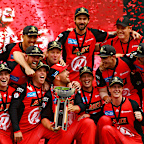
Following months of speculation, Cricket Australia on Tuesday announced the Melbourne Renegades would be put up for sale, with the hope the franchise will play in the 2027-2028 summer under new ownership.

Cricket Australia announced the Melbourne Renegades franchise will be put up for sale. Getty
Pending the success of the sale, CA would then investigate expanding the model further through the competition.
The NSW and Queensland cricket associations were both staunchly against privatisation.
Andrew Jones was Cricket Australia's general manager of strategy between January 2010 and December 2012. The first edition of the BBL was held in the summer of 2011-12.
In a lengthy rant on LinkedIn, Jones accused the organisation of "selling the farm to pay for the stock" and labelled the decision "short-sighted and sad".
“CA is giving up control of its product portfolio and schedule. It will answer to private owners in choosing dates for Tests and BBL matches – as in India, the UK and South Africa – instead of optimising the two. Mad,” he wrote.

"CA is giving up future revenue in exchange for a lump sum payment. This lump sum payment will inevitably be used to spend more in the short-term while creating a revenue gap almost immediately. Negligent.
"CA is ignoring the advice of two of its three biggest states. NSW and Queensland represent 55 per cent of Australia’s population and produce a majority of its best cricketers. Disrespectful.
“Australian cricket’s ecosystem has worked well for a long time and made it our national sport. International cricket and BBL create Australian fans and participants, and fans and participants create revenue and elite Australian cricketers. Private investors have different objectives. Naive.
“Australian cricket is owned by the public, not the CA board, and is not CA’s to sell. Hubris.”
Jones concluded by declaring "most of us involved in the BBL's creation are bemused and/or appalled".
"CA is the custodian of the Australian game. Its job is to steward the game, not sell it."

Cricket Australia is hopeful the Renegades will compete in the 2027-2028 BBL under private ownership. Getty
When the BBL owned the Aussie summer
The Big Bash League was once a staple of summer television. Now, few could even say when the upcoming season starts.
Looking back, the BBL peaked in the summer of 2016-2017. Three seasons later, it was on life support, and then the pandemic happened.
A tick over 30,000 fans on average would stream through the gates to see the likes of Chris Lynn, Shane Watson, Aaron Finch and Moises Henriques score runs for fun. They were bolstered by some of the biggest names from abroad, including Brendon McCullum, Stuart Broad, Kieron Pollard and Kevin Pieterson.
On New Year’s Day 2017, more than 71,000 braved a dreary Melbourne day to pack into the MCG to watch the derby between the Stars and Renegades. A year earlier – when the weather was stunning – 80,883 had packed in to watch the same match.
TV figures were insane too – an estimated 944,000 Australians were tuning in to watch the games on Channel 10.
But then execs at Cricket Australia got greedy, and the tournament had its jump the shark moment.

A competition-record 80,000 packed into the MCG for the derby between the Renegades and Stars on January 2, 2016. Getty
Once packaged into a four-week window entirely inside the school holidays, the competition expanded from 35 matches to 61 just three seasons later. Average attendance nearly halved, and the cumulative attendance across the season only increased by about 80,000.
At the same time, unpopular rules experiments like the Bash Boost (a point awarded to the team in front at the 10-over mark) and the X-Factor (an extra player subbed into the match at the 10 over mark under specific conditions) were implemented. Both have since been repealed. The Power Surge – basically the usual fielding restrictions rebranded – remains.
The TV rights were also snapped up by Seven as a part of their massive coup to begin broadcasting the men's home international matches.

But fans voted with their feet. Excluding the COVID-effected 2020-21 and 2021-22 seasons, average attendance in the 2022-23 season was just 16,720. Seven of the 10 highest attendances that year were in Perth. TV viewership had almost halved to an estimated 550,000.
It was grim.
The tournament was compacted for the 2023-24 summer, and average attendance got an immediate boost. In 2025-26, cumulative attendance ticked over one million for the first time in four seasons, and average attendance was back up to nearly 25,000.
So with numbers seemingly on the improve, the timing of Cricket Australia's decision to privatise the competition seems baffling.
But it also comes at a time of significant loss of revenue from two-day Test matches.
Whatever the reason, CA will no doubt be hopeful the Melbourne Titans – or maybe the Super Kings, Knight Riders or Sunrisers – becomes a successful venture.
Oh, and for those wondering, the opening match of the BBL season – ironically between the Renegades and Scorchers – will be played in Chennai on December 12.