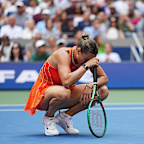
'Don't lose being passive': Nightmare US Open final loss fuelling Keys' newfound mental toughness
The Madison Keys who will play two-time defending champion Aryna Sabalenka for the title at the Australian Open on Saturday night is not the same Madison Keys who was the runner-up at the US Open back in 2017, the only other time the American played in a grand slam final.
Her racquet is different, for one thing – a switch made ahead of this season to help protect her right shoulder and offer more controlled power.
Her coach is different, too, as of 2023: her husband, Bjorn Fratangelo. And her mindset is different.
READ MORE: Aussie coach praised for Sinner's killer approach
READ MORE: Djokovic chasing shadows as GOAT makes grim injury admission
READ MORE: Rugby minnow makes history with stunning win over Kiwis
The 6-3, 6-0 loss at age 22 to her close friend Sloane Stephens at Arthur Ashe Stadium with a trophy at stake helped shape the way Keys will approach matters when she steps into Rod Laver Arena less than a month before her 30th birthday.

Madison Keys upset world No.2 Iga Swiatek in the semi final. Photo by Darrian Traynor/Getty Images
After that US Open final, in which she made 30 unforced errors, Keys acknowledged not having “handled the occasion perfectly” and figured her performance "came down to nerves and all of that.”
The experience stuck with her.
“I’ve obviously thought of that match endlessly for the past eight years,” Keys said. “During that match, I was so consumed with being nervous and the moment and the opportunity and all of that, that I never really gave myself a chance to actually play.”
It took her a while to realise that the problem wasn't so much the jitters themselves. Those are normal. Everyone feels them.
Instead, she needed to learn not to worry about them and swing away.
Watch the Australian Open live & free on the 9Network & 9Now. Stan Sport is the only place to watch every match ad-free, live & on demand with centre court in 4K.
“I’ve done a lot of work trying to NOT get rid of nerves, because I think in the past, in my head, it was kind of always, ‘The people who play amazing in the tight moments, they either don’t have nerves or they figure out how to get rid of them'," Keys explained.
“The big thing for me has just been knowing that there are going to be a lot of moments where I’m uncomfortable in the match. It’s going to be stressful. You have thousands of people watching you. You might not be playing your best tennis,” she said. "But instead of trying to shy away from that and search for settling or comfort or anything, just being OK that that’s the situation — and you can also play tennis through that — is something that I’ve been working really hard on.”
And so there Keys was in the semi finals in Melbourne, not merely in the crucible of a third set against a former No.1 and five-time grand slam champion in Swiatek, but even standing one point from defeat at 6-5, 40-30.
The 19th-seeded Keys then trailed 8-7 in the third-set tiebreaker, two points from defeat. She wouldn't drop another point on the way to closing out the 5-7, 6-1, 7-6 (10-8) victory.
“At the end, Madison was kind of brave with her decisions,” said Swiatek, who lost more games to Keys in the semifinal than the 14 in her previous five matches combined.
Whatever self-doubt might have been present by Keys was masked rather effectively.
“That's probably one of the biggest lessons that I can take from that US Open final — just be OK with knowing that I’m probably going to be uncomfortable 99 per cent of the time that I’m on the court,” Keys said, “and that’s OK."
Fratangelo, a former professional player, has emphasised to Keys that she needs to stick to her point-ending quick strikes.
When Keys went to a third set against 2022 Wimbledon winner Elena Rybakina in the fourth round of this Australian Open, Fratangelo reminded his wife of the need to stay aggressive.
His message?
“Don’t lose being passive, because it’s not who you are. Let a counterpuncher lose being passive, because that’s what they do,” he said. “You lose putting your foot on the gas pedal, and that’s OK."
That is also a perfect description of Sabalenka's style. She's learned to control her strokes, and will mix in a slice or drop shot every so often, mind you, but the grunt-accompanied huge serves and groundstrokes are still her hallmarks.
As is her lack of hesitation.
“What's really impressive is her mentality — her ability to kind of always go for it, no matter what the score is,” Keys said.
Keys tries to emulate that aspect of the top-seeded Sabalenka, listed as the favourite, as she tries to become the first woman since Martina Hingis in 1997-99 to win three consecutive Australian Open trophies.
“She plays such fearless tennis. She has the ability to play so well that way. It’s very unique,” said Keys, whose 1-4 career record against Sabalanka includes a loss in the US Open semifinals two years ago.
“A lot of people, no matter what, even if it was a tight point, you kind of expect them to play a little bit more conservative or back down a little bit, and you know she’s not going to do that.”