National emergency test hailed as success even as some phones stay silent
Millions of phones blared out the same high-pitched alarm in what the government is touting as a largely successful test of the new national AusAlert system, with 94 per cent of all targeted towers transmitting the warning message.
The AusAlert test ran from 2-2.15pm AEST on Monday on compatible phones, smartwatches and tablets.
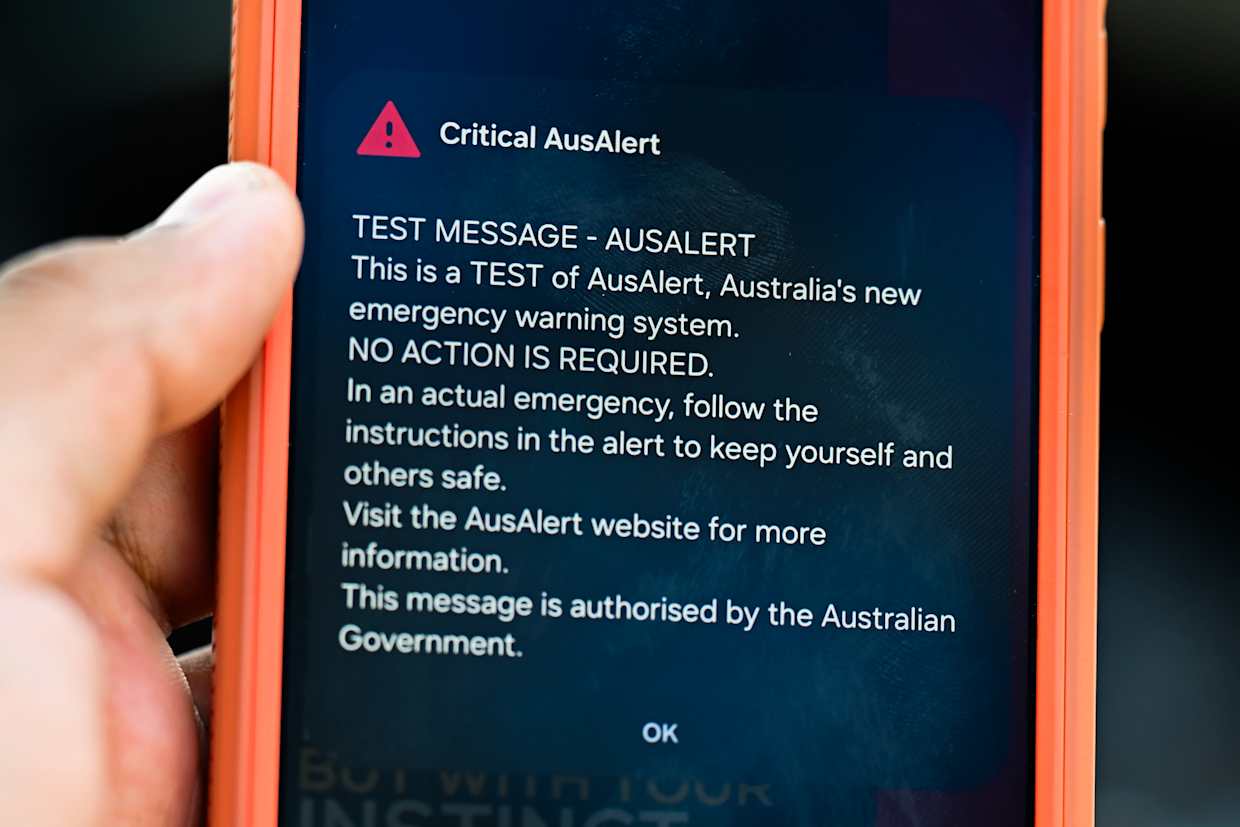
Millions of phones lit up during the AusAlert test. Getty Images
Millions of phones around the country emitted a loud, siren-like alarm that lasted for about 10 seconds while a large notification appeared on home screens.
Some phones displayed the words “presidential alert” instead of “critical AusAlert” – an error due to older phones being programmed differently – while others did not receive an alert at all.
Emergency Management Minister Kristy McBain said 94 per cent of targeted phone towers had successfully broadcast the test alert, while the remaining 6 per cent failed to do so as they were offline for various reasons.
“The test has shown AusAlert’s capability to deliver emergency warnings at pace and scale, with 94 per cent of targeted towers broadcasting across Australia,” she said.

“The 6 per cent of towers relate to towers that are offline for maintenance, that are being upgraded, or have other things happening at that point in time.”
McBain smoothed over concerns about the number number of Australians who missed out on the alarm.
“Don’t worry if you did not receive an alert,” she said.
This could be because you were not in a coverage area, your software was not up to date, or your device was incompatible.”
McBain said anyone who has a second phone for safety reasons – such as domestic violence victims – should keep it turned off or in aeroplane mode for the 24 hours following the test as a precaution.
By design, the alert overrode phones that were on silent or do not disturb mode.
“We worked really closely with family and domestic violence organisations who have created a safe phone guide,” McBain said.

Kristy McBain hailed the test as a success. Alex Ellinghausen
The National Emergency Management Agency (NEMA) will review Monday’s test and make any necessary changes so it is ready to use when AusAlert is officially rolled out in October.
“Today’s test was all about understanding how AusAlert performed at scale across millions of devices and at hundreds of different environments,” NEMA interim coordinator-general Patrick Hetherington said.
“NEMA will now assess all of the data, including reports from our technical and operational partners, jurisdictions, and community feedback.
“We’ll do a deep dive into all aspects of today’s test and make any necessary modifications to the system so that AusAlert is ready for the Australian government and emergency service organisations to use from October 2026.”
The AusAlert system will deliver emergency messages to the Australian public once it is officially rolled out in October.
The $132 million system is slated to replace the current state-based SMS emergency alerts.
It will send alerts to phones if there is a national disaster, major incident or a threat to public safety.

“At the end of the day, 99 per cent of the time, states and territories will be using this system and it’ll be the lead emergency agency, of whatever the event is, that’ll be sending out these notifications to advise people of what the incident is, how serious it is, and where it’s located, and where you can go for more advice,” McBain said.
In an actual disaster, an AusAlert will tell you:
- The type of emergency
- Where it’s located
- How serious it is
- What to do
- The name of the emergency organisation that has sent the AusAlert
- Where to find more information about the emergency.
States and territories had previously raised concerns about whether it will be able to contact landlines for remote households.
The government insisted that the Emergency Alert system, which has the capability for an automated voice to deliver messages to landlines, will continue to run alongside AusAlert for the 12 per cent of Australians with a landline and 2 per cent reliant on a landline.

Share a tip-off, video or photo with us
Most viewed in Australia
Australian woman who died after falling from cliff near Bali was Queensland ecologist
PM ‘stunned’ over Pauline Hanson’s attack on his late mother
Police called to One Nation event after clash between passer-by and volunteer
Six years ago, Australia had a $38 billion early super experiment. It didn’t go to plan


