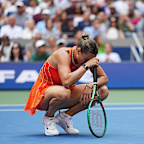
'Total mess': Late finishes continue at US Open despite new tournament rule

It's the same old story every grand slam - concerns over player welfare regarding late finishes.
But it wasn't supposed to be that way at this year's US Open.
Organisers in New York introduced a new rule for this year's tournament, which stipulated that a match, which had not started by 11.15pm due to an ongoing previous match, should be moved to another court.
Watch the 2024 US Open tennis for free on 9Now. Every match will be ad-free, live and on demand with Centre Court in 4K UHD on Stan Sport.
With four arenas available, players' concerns were allayed as tennis officials looked to put their health first before entertainment.
However, it has not panned out that way as the debate over scheduling was underscored by matches finishing as late as they've ever finished.

Getty
Reports from Flushing Meadows state that some matches finished so late, that most fans opted to hit the sack rather than stick around and soak in every bit of the action.
Only a few hundred people were in attendance when Zheng Qinwen of China and Croatia's Donna Vekic faced each other in a rematch of the Olympic gold medal match. The contest finished at 2.15am local time, setting a new record for the latest women's match at the tournament..
The third-round fixture between Germany's Alexander Zverev and Tomas Martin Etcheverry ended after 2.30am, which was the second-latest finish in US Open history.
The latest match to finish at Flushing Meadows was the 2022 clash between Carlos Alcaraz and Jannik Sinner, which lasted until 2.50am.
READ MORE: Aussie Leary breaks record to win Paralympic gold
READ MORE: Family's emotional message to critics after Aussie's bronze
READ MORE: 'Sorry' Raygun breaks silence on Olympics saga
"The tennis scheduling situation is a total mess," Andy Murray wrote on X.
Players have long railed against late starts over health concerns and a 2019 study from Germany claims they have a point.
The Ruhr University study highlighted the importance of sleep in competitive sport, with sleep loss leading to slower reaction times and cognitive performance.
The study reports that concentration, memory and decision-making were worse in tests for adults who had slept for less than seven hours.
"Sleep determines cognitive and motor performance," Dr Utz Niklas Walter said in an interview with German sports doctors' periodical, "Sportärztezeitung."
"The more restful the night's sleep, the more likely it is that the body will perform at its best and adapt positively.
"There should be about two hours between intensive sporting activity and going to bed. This time should also be used to think about things other than competitive sport."
German broadcaster Deutsche Welle reports the number of night matches at the Grand Slam tournaments in Melbourne, Paris and New York has doubled since 2018, according to the Professional Tennis Players Association. The player's union says players are 25 percent more likely to be injured during a late match.
"There needs to be a greater focus on players' health," PTPA Deputy Executive Director Romain Rosenberg told the DPA news agency.
"It's no wonder that players pull out of tournaments, are broken and injured. The physical and mental fatigue is real."
Speaking to reporters at the Open about his late finishes, Zverev defended organisers, saying there's "not much the tournament can do."
"Maybe the night sessions could be started earlier," said the 2021 Olympic champion who holds the record for the latest tennis match in history.
His match against Jenson Brooksby at the ATP tournament in Acapulco in 2022 ended at 4.55am local time. He was then disqualified in his next match for throwing temper tantrum.
"There's nothing to blame them for," Zverev said when asked about the late finish against Etcheverry at this year's US Open.