- Analysis
- Sport
- Rugby
- Rugby Union
'Unbelievable' Wallabies weapons shifting the World Cup narrative

Updated . First published at
The measure of the Wallabies’ heartening performance against Ireland wasn’t necessarily discovered on the scoreboard. It was that the dessert was just as good as the main course played out across the ditch a few hours earlier.
For those who missed it, the All Blacks’ 34-32 victory over Les Bleus under the roof in Christchurch was international rugby at its very best.

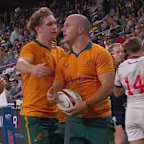
Wallabies players were left to lament another match that got away from them. Getty Images
While the All Blacks’ five tries to four ultimately proved the difference between the two sides, Fabien Galthie’s French made 12 linebreaks to the home side’s 11 in a sign of just how competitive and breathtaking the contest was.
What the stats didn’t show was just how physical the contest was, the brutality of it, and the supreme pace of the Test either.
Having witnessed the All Blacks hang on, many hoped that the Wallabies’ clash against Ireland would similarly capture the imagination of the sold out Sydney crowd, unlike many of the Super Rugby fizzers that follow New Zealand derbies. It certainly did.
Joe Schmidt’s Wallabies were a mere missed penalty away in the 82nd minute from downing the world No.3 side.
Had they done so, the Wallabies would have been declared to be back. Again.

Instead, the Wallabies have now lost eight of their past nine Test, including their past five.
Should they go down to world No.4 France on Saturday in Brisbane, Schmidt’s Wallabies will become the first side since Michael Cheika’s team to lose six straight games.
But beyond the agonising two-point defeat, there were plenty of green shoots for the Wallabies in a positive sign 15 months out from the home World Cup.
Attacking intent
It didn’t always work, but the Wallabies attempted to stretch the Irish right from the opening kick-off by putting the ball through the hands deep inside their own 22.
It almost came unstuck on a couple of occasions early, but the endeavour was on display all night and largely worked.
Indeed, the Wallabies made 10 linebreaks to Ireland’s four, with the home side’s lightning-fast work at the breakdown ensuring the visitors were scrambling for much of the first half.
Rob Valetini played like a man possessed, and his bulldozing approach allowed halves Ryan Lonergan and Carter Gordon to unlock the Wallabies’ backline.
Gordon, in particular, showed why Schmidt put his faith in him at No.10.
The 25-year-old showed he is the best running threat in Australia by taking on the Irish line and splitting it.
Streaking through the middle of the Irish defence was a sight to behold.
But his ability to pull the trigger and sum up the situation was also on display as he played a strong hand in the Wallabies’ opening two tries.
The Reds’ influence was also on show with Gordon receiving clever short passes from lock Josh Canham, while Jock Campbell, who starred in his first Test in almost four years, was also at the heart of the opening two tries.

Dylan Pietsch of the Wallabies celebrates scoring a try Getty Images
Threats that give Wallabies hope for home World Cup
Despite Farrell’s side prevailing, the Irish coach would have looked at Australian rugby with a bit of envy.
In Angus Bell, Taniela Tupou, Valetini and Suaalii, the Wallabies have firepower that Ireland quite simply can’t match.
Sure the Irish are well-drilled and methodical, and are used to winning thanks to the Leinster juggernaut, but they don’t exactly have the threats to consistently challenge the top teams when it comes to World Cups.
The Wallabies, however, do – and it’s one of the things that is going for the men in gold, especially if their big men stay on the park.
Farrell even said as much when he was asked about the Wallabies’ ability to carve Ireland up on the fringes.

Rob Valetini makes a break. Getty Images
“No, not surprised by it, because we know that’s what they can do,” Farrell said.
“They’ve got some unbelievable athletes, and the breakdown stuff is a trademark of Australian rugby. And it’s certainly a trademark of Joe Schmidt’s teams as well.”
Surprise Reds pick should keep his spot
Campbell may have been the biggest bolter to earn selection in the first Test, but the 31-year-old more than justified his spot.
The off-contract Reds fullback threw the final pass ahead of the Wallabies’ first try and then scored the home side’s second.
He was caught out of position once or twice by Jamison Gibson-Park’s big boot, but was calm and composed for the majority of his stint at the back for the Wallabies.
It was no surprise that Schmidt kept the fullback on the field for 77 minutes, before injecting Tom Wright – the Wallabies’ usual no.15 – off the bench.
Presuming Gordon, who was replaced at 57 minutes because of “cramp”, is in fact fit, Schmidt should stick with Campbell at fullback.
And if he is, there’s no reason to have Wright on the bench.
Instead, Schmidt should consider picking Reds utility back Filipo Daugunu, whose form in Super Rugby was excellent, in the No.23 jersey instead.
Wilson question won’t go away
Les Bleus and their army of big men, including Australian-raised Emmanuel Meafou, are coming. And that will give the Wallabies another selection headache to consider this weekend.
It was one thing for the Wallabies to physically beat up Ireland. They’ll find it much harder against France.
The French have an embarrassment of riches to pick from and Tom Staniforth, the ruck-hitting Australian-born-and-raised lock, who was excellent on debut against the All Blacks, might not even retain his spot.
Mickaël Guillard could start, but Meafou – the Toulouse star, who somehow was overlooked despite being in the Australian system – is another bound to return to the match day squad.
That bigger physical threat could see Schmidt reconsider his back-row balance.
Valetini was Australia’s best player by a country mile against Ireland, so the loose-forward is a lock to take on France.
Can the same be said about captain Harry Wilson?

Harry Wilson of Australia is interviewed at fulltime. Getty
The No.8 personifies everything about this popular Wallabies side, but the loose-forward also couldn’t stop two tries on his line and he ultimately made the decision to point to the sticks. That can’t necessarily be held against him, but the captain lives and dies by the accuracy of the decisions he makes.
Would the Wallabies be better served by shifting Valetini to No.8 and bringing in Tom Hooper, whose size, physicality and work-rate will be needed against France?
It’s certainly something to consider.