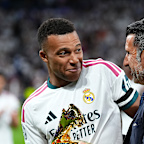
Champions League starts bigger new era with Mbappé at Madrid and rematches of past finals
The new Champions League format kicks off on Wednesday (AEST) after more than six years of planning, one failed proposal and one Super League launch fiasco.
In the end, storied clubs who pushed for change from UEFA and created turmoil in European football got most of what they wanted: More teams, more games and more of them against strong opponents, more money.
Now there are 36 teams instead of 32, each playing eight games instead of six, against eight different opponents instead of three.
Watch every match of the 2024-25 UEFA Champions League, streaming ad free, live and on demand on Stan Sport
Opening day hits a high note.
Kylian Mbappé starts his quest for a first title with his third club, the record 15-time European champion Real Madrid that hosts Stuttgart.
Mbappé reached the semi-finals in 2017 with Monaco and was a beaten finalist in 2020 with Paris Saint-Germain.
READ MORE: Bennett's brutal 'serve' to Bunnies revealed
READ MORE: Matildas name interim coach after Gustavsson exit
READ MORE: Cornes whacks 'arrogance' as one Giant singled out
Ultimately, all 36 teams will be ranked from top to bottom in a single league standings that finishes in January instead of traditional four-team groups that would end in December.
UEFA has cleared its midweek schedule to relaunch the marquee club event over back-to-back-to-back nights – six games each through Friday (AEST).
The new format
The league phase through January is quite simple. Each team plays a balanced schedule of eight games — four at home, four on the road — earning three points for a win and one for a draw.
Eight different opponents were allocated in the draw last month by a software program picking two teams from each of four seeding pots. Seeding was based on a team's UEFA ranking over five years of results in European competitions.
Recent champions Madrid, Manchester City and Bayern Munich were among the top seeds. Low-ranked pot four included debutants Girona and Brest, and long-time absentees Aston Villa, Bologna and Stuttgart.
Advancing to the knockout phase is more complex, and UEFA suggested teams will need eight points from eight games to stay involved.
The top eight in the standings on January 30 (AEST) go direct to the round of 16 in March seeded 1-8.
Teams placed ninth to 24th in the standings enter a knockout playoffs round in February. Teams 9-16 will be seeded in the draw and play second legs at home against teams who placed from 17-24. The bottom 12 teams in the standings are eliminated.
The eight playoff winners advance as unseeded teams in the round of 16, which will be drawn into a set bracket like a tennis tournament. That replaces the old system of separate draws for the quarter-finals and semi-finals.
Wednesday starts with 'Miracle' rematch
The new era starts with two early kickoffs featuring three European Cup winners from the 1980s — Juventus (1985) hosts PSV Eindhoven (1988) and Aston Villa (1982) travels to Young Boys. Both are first-time fixtures between the teams.
Also playing are the four teams with the most European Cup and Champions League titles in their 70-season history.
While Madrid plays Stuttgart, six-time winner Bayern hosts Dinamo Zagreb looking to extend a 40-game, seven-year unbeaten run in group stages.
The standout pairing is AC Milan against Liverpool at San Siro. Milan won the last of its seven European titles in the 2007 final against Liverpool. That was a rematch of the 2005 'Miracle of Istanbul' final when Liverpool rallied from 3-0 down at halftime to win the fifth of its six titles.
Man City-Inter meet again Thursday
A more recent rematch of another Istanbul final features the current champions of England and Italy. Manchester City, riding Erling Haaland's hot start to the season, hosts an Inter Milan it beat 1-0 in the 2023 final and is unbeaten in Champions League home games for six years.
It is also a night for fresh faces. Girona, which is in the same Abu Dhabi-backed ownership group as Man City, will make its European debut at Paris Saint-Germain.
Bologna hosts Shakhtar Donetsk in its first game in the competition since a preliminary round exit 60 years ago. Bologna still plays in the Stadio Renato Dall'Ara that has been its home since 1927 and staged games at the 1934 World Cup.
Leverkusen and Atalanta step up Friday
The Europa League finalists last season now rise together to the bigger stage.
Bayer Leverkusen's only loss in a remarkable first full season under coach Xabi Alonso was that Europa final against Atalanta. Now Leverkusen returns to the Champions League at Feyenoord, whose coach last season Arne Slot took the job at Liverpool that was first offered to Alonso.

Xabi Alonso of Bayer Leverkusen celebrates at BayArena in Leverkusen. Getty
Atalanta hosts Arsenal which has lost captain Martin Odegaard to an ankle injury suffered playing for Norway on Monday.
La Liga leader Barcelona with 17-year-old star Lamine Yamal goes to Monaco and the most unlikely fixture of all 18 this week is Brest vs Sturm Graz.
Brest, founded 121 years ago, has never played a European game and Sturm last played in the Champions League 23 years ago. The game is being played at Guingamp, 110km east of Atlantic port city Brest, whose home stadium is not modern enough.

Toni Kroos of Real Madrid celebrates with teammates after winning. Getty
More prize money
UEFA has put at least $4.1 billion into the prize money fund for the 36 clubs, a 25 per cent raise on last season. The title winner in Munich on June 1 (AEST) can expect to get more than $260 million.
Each team gets a basic $30.6 million, then $3.46 million for each league-phase game won and $1.15 million per draw.
Each place in the standings is worth more money with shares of $453,000 per place: 36 shares, or $16.32 million, goes to the team finishing top in January and a single share to the last-place team.
Bonuses escalate from $18.14 million per team for advancing to each knockout round.
Another prize fund of $1.4 billion is allocated based on teams' historical record in UEFA competitions and the value of national and global broadcast deals.